


- Personal Injury
- Housing Arrangements and Home Modifications After a Spinal Cord Injury
It is completely normal to feel afraid about going home after a spinal cord injury. Home may be familiar, but life can feel very different now, and it is understandable to worry about how you will manage, what will change, and what the future will look like. Fear does not mean you are weak; it means you are facing something major, and you deserve support as you adjust to your new life.
Getting Ready for a Life of Change
For most spinal cord injury survivors, the moment of discharge from inpatient rehabilitation is supposed to feel like a victory. In reality, it is often where the next struggle begins. The hospital has stabilized the injury. The rehab team has taught the survivor how to transfer, dress, eat, and roll. But the home they are returning to was designed for an able-bodied life that no longer exists — narrow doorways, raised thresholds, second-floor bedrooms, a tub that cannot accommodate a wheelchair. Without the right housing arrangements in place before discharge, that homecoming can stall recovery, prolong hospitalization, and add tens of thousands of dollars in avoidable costs.
Our Hamilton spinal cord injury lawyers have helped survivors and their families navigate this transition since 2003. We know how many moving parts go into a safe homecoming, how often critical assessments get missed, and how Ontario’s accident benefits system can — and cannot — be leveraged to fund the changes a survivor needs. This guide walks through what proper housing planning looks like after a spinal cord injury, what modifications are typically required, what they cost, and how Ontario law and provincial programs can help pay for them.

Over $30 Million Recovered. Call Today to Start your Case.
Contact Us Today
Why a Safe, Accessible Home Matters More Than Most People Realize
A complete spinal cord injury permanently disrupts motor and sensory function below the level of injury. Survivors rely on wheelchairs, transfer equipment, and assistive devices to perform tasks that once required no thought at all. There is no cure, and the adaptations made to the home environment will shape the survivor’s independence, safety, and dignity for the rest of their life.
The right home does more than enable mobility. It restores stability at a moment when stability has been ripped away. Spinal cord injury survivors frequently experience anxiety, depression, and post-traumatic stress in the months following the trauma, and the familiarity of one’s own home — modified to permit independent living — is one of the most powerful psychological anchors available during recovery. A home that cannot accommodate the survivor, by contrast, forces continued dependence on family members or institutional care, both of which are linked to poorer mental health outcomes and slower functional gains.
Housing planning, in other words, is not a logistical afterthought. It is a clinical priority.
A New World of Physical Barriers Inside Your Own Home
Family members and caregivers often underestimate how hostile a typical Canadian home is to a wheelchair user. Doorways are too narrow. Hallways force awkward turns. Bathrooms are designed around bathtubs and standing transfers. Kitchens place everything just out of reach. Even surfaces that seem benign — area rugs, carpet, uneven hardwood, a lip between the kitchen and the dining room — become daily obstacles.
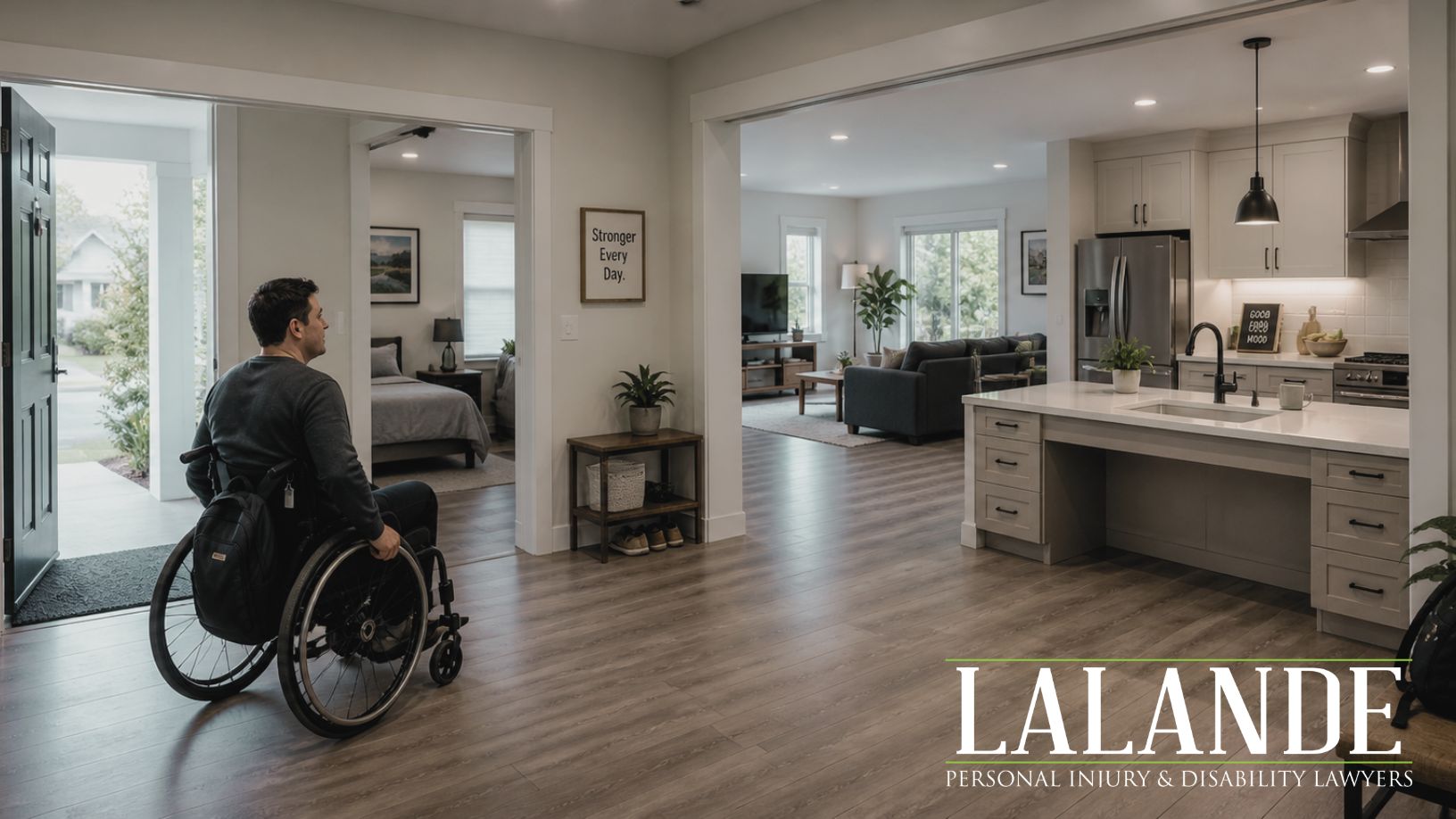
The barriers a spinal cord injury survivor will encounter on the first day home commonly include staircases and split-level entries, narrow doorways and hallways, raised thresholds, inaccessible decks and porches, carpeted or uneven flooring, doors that do not stay open long enough for a wheelchair to pass through, and high or out-of-reach light switches, sinks, cupboards, mailboxes, appliances, and countertops. None of these obstacles is dramatic on its own. Together, they make independent living impossible.

The Most Common Home Modifications for Spinal Cord Injury Survivors
Every survivor’s needs are different, and the modifications required depend on the level and completeness of injury, the layout of the existing home, and the survivor’s goals around independent living. That said, certain modifications appear in almost every spinal cord injury home accessibility plan in Ontario:
- Entry access, including indoor and outdoor ramps, widened or zero-threshold entryways, and automatic door openers
- Doorway and hallway widening — doors should generally measure between 81.5 cm and 86 cm (32 to 34 inches) wide to accommodate most wheelchairs
- Bathroom renovations, including roll-in or curbless showers, grab bars, accessible toilets, and accessible vanities
- Kitchen modifications, including lowered countertops, lowered or front-control appliances, and roll-under sinks
- Vertical access, including stair lifts, platform lifts, or residential elevators where the home has more than one storey
- Flooring changes — replacing carpet with hardwood, vinyl, or another smooth, non-slip surface
- Hardware swaps, including lever-style door handles, lowered light switches and outlets, and rocker switches
- Bedroom modifications, including ceiling track lifts, hospital beds, and accessible closets
- Climate control upgrades to ensure adequate heating and insulation, since many spinal cord injury survivors lose the ability to regulate body temperature below the level of injury
A skilled accessible-housing specialist will tailor these modifications to the survivor’s lifestyle. Cooking, gardening, working from home, raising children — each activity changes what “accessible” actually means in practice.
The Critical Role of the Occupational Therapist
In Ontario, the foundation of any home modification plan is the home accessibility assessment performed by a registered occupational therapist (OT). The OT visits the home before discharge wherever possible, evaluates every aspect of the living environment, identifies barriers, recommends specific modifications and equipment, and prepares a detailed report that goes to the insurer for funding approval.
This sequence matters. Home assessment reports must typically be approved by the insurer before any work begins, and accident benefits insurers will not reimburse for work completed without prior authorization. Survivors who race ahead with renovations before the OT report and insurer approval are in place often find themselves paying out of pocket for changes that should have been covered.
When Your Home Cannot Be Modified: Alternative Housing Options in Ontario
Not every home can be made accessible. Older homes, multi-storey homes without space for an elevator, narrow urban townhouses, and rural homes with septic or well limitations sometimes cannot accommodate the changes a survivor needs — or the cost of doing so exceeds the cost of buying or building an accessible home elsewhere.
Ontario’s accident benefits regime specifically contemplates this scenario. If the existing home cannot reasonably be modified, an insurer may fund the purchase of a new, accessible home, subject to limits and a comparison against what the renovation would have cost. Where renovation is possible but the survivor needs interim accommodation, several options exist:
- Transitional living facilities offer accessible, short-term arrangements (typically 6 to 18 months) for survivors who are awaiting modifications or a permanent placement. The Ministry of Health funds 24/7 attendant care in these settings, though residents pay their own living expenses.
- Long-term care homes can provide up to roughly 2.5 hours of personal care per day, plus 24-hour nursing support, for survivors whose needs cannot be met in the community.
- Supportive and independent living communities offer varying levels of attendant care in accessible apartment-style settings, though wait lists are common, especially outside major centres.
Spinal Cord Injury Ontario maintains an excellent housing resource that can connect survivors to local accessible-housing specialists, contractors, and real estate professionals. Our team also maintains a network of occupational therapists, life care planners, and modification specialists across Ontario, and we routinely connect clients with the right people early in the process.
How Ontario’s Statutory Accident Benefits Schedule (SABS) Pays for Home Modifications
For survivors injured in a motor vehicle accident, the primary funding source for home modifications is Ontario’s Statutory Accident Benefits Schedule (SABS), a regulation under the Insurance Act. Section 16 of the SABS provides for rehabilitation benefits, which include workplace and home modifications, vehicle modifications, assistive devices, and other goods and services intended to reduce or eliminate the effects of the disability.
How much funding is available depends on whether the injury meets the SABS definition of catastrophic impairment under section 3.1(1). Spinal cord injuries causing paraplegia or tetraplegia frequently qualify when the criteria around neurological level, motor and sensory function, permanence, and reliance on mobility devices are met. For non-catastrophic injuries, the medical, rehabilitation, and attendant care benefits are limited to a combined $65,000. Where the injury is designated catastrophic, that combined limit jumps to $1,000,000.
That $1 million cap sounds like a lot until you start spending it. Home modifications, attendant care, mobility devices, ongoing physiotherapy, psychological treatment, and assistive technology all draw from the same pool. Every dollar spent on a roll-in shower or a stair lift is a dollar unavailable for the next 30 years of attendant care. Allocating the SABS budget intelligently — and fighting to expand it where possible through the tort claim — is one of the most important things a spinal cord injury lawyer does for a catastrophically injured client.
The SABS also allows the insurer to fund the purchase of a new home where renovation of the existing home is not feasible or not cost-effective, subject to the same combined limits.
For non-MVA injuries — workplace falls, sporting accidents, slip-and-falls — funding will come from a different mix of sources, which we discuss below.
The Real Cost of Accessible Housing After a Spinal Cord Injury
The lifetime cost of a traumatic spinal cord injury is staggering, and home modifications represent only one slice of the total. Canadian peer-reviewed research has placed the lifetime economic burden of a complete tetraplegia injury at roughly $3 million in 2011 dollars, with home modifications and equipment accounting for over 11% of direct costs and attendant care driving close to one-third. More recent legal commentary in Canada places the all-in lifetime cost of a serious spinal cord injury between $1.5 million and $3 million when home modifications, vehicle modifications, lost income, and round-the-clock care are factored in.
Home modifications themselves vary enormously based on the level of injury, the home, and the scope of work. Survivors and their families should expect to budget within these general ranges:
- A wheelchair ramp: roughly $1,500 to $3,500
- Doorway widening: $500 to $5,000 per doorway
- Bathroom renovation with roll-in shower, grab bars, and accessible fixtures: $9,000 to $25,000
- Accessible kitchen with lowered counters, roll-under sink, and accessible appliances: $13,000 to $38,000
- Stair lifts, platform lifts, or residential elevators: $1,000 for basic stair lifts up to $60,000 for an enclosed home elevator
- Whole-home accessibility renovations: typically $20,000 to $100,000, with high-end retrofits exceeding that
Beyond construction, survivors face contractor and architect fees, building and zoning permits, temporary housing during renovation, real estate and moving costs where relocation is necessary, and occupational therapy fees for ongoing reassessment as needs change over time.
These costs are recoverable as part of a properly framed claim, both through the SABS and through any tort claim against the at-fault party, but only if they are documented, supported by expert evidence, and projected over the survivor’s full life expectancy.
Funding Beyond SABS: Other Resources Available to Ontario Survivors
For survivors whose injuries did not arise from a motor vehicle accident — or whose accident benefits have been exhausted — several other funding sources exist in Ontario:
- The Home and Vehicle Modification Program (HVMP), funded by the Ontario Ministry of Children, Community and Social Services and administered by March of Dimes Canada, provides up to $15,000 over ten years for basic home modifications and additional funding for vehicle modifications. The program is income-tested and demand far outstrips supply: in a recent year, the HVMP funded only about one-third of the more than 3,000 applications it received.
- The Workplace Safety and Insurance Board (WSIB) covers home modifications for survivors whose injury occurred in the course of employment.
- The Ontario Disability Support Program (ODSP) provides income support and certain benefits to qualifying survivors.
- Veterans Affairs Canada provides home modification funding for veterans with service-related injuries.
- The federal Disability Tax Credit and the Home Accessibility Tax Credit offer tax relief for accessibility expenses.
- Spinal Cord Injury Ontario offers peer support, housing navigation, and connections to vetted accessibility contractors throughout the province.
A spinal cord injury lawyer can help survivors stack these sources strategically — making sure, for example, that an HVMP application is filed where appropriate without compromising the SABS or tort claim.
Why $1 Million in Catastrophic Benefits Is Rarely Enough
Ontario requires drivers to carry minimum third-party liability limits of $200,000, although most brokers will not even sell coverage that low. Standard policies typically carry $1 million or $2 million in liability limits, with optional buy-up coverage available. On the accident benefits side, the catastrophic medical, rehabilitation, and attendant care limit is $1,000,000, with optional buy-ups to $2,000,000 or more.
For a survivor in their thirties or forties with a complete spinal cord injury, those limits will not last. Lifetime attendant care alone can exceed $150,000 per year. A wheelchair-accessible van runs $40,000 to $80,000 and needs to be replaced over a survivor’s lifetime. Power wheelchairs can cost up to $45,000 and require replacement every five to seven years. The home modifications described above can consume a six-figure share of the SABS budget on day one.
This is why a properly run tort claim against the at-fault driver — pursued in parallel with the SABS claim — is essential. The tort claim is where future care, lost income, lost competitive advantage in the labour market, and pain and suffering are recovered, and where life care plans, vocational reports, and actuarial evidence build the case for full compensation.
How Our Hamilton Spinal Cord Injury Lawyers Can Help
Since 2003, Matt Lalande has represented spinal cord injury survivors across Ontario and recovered more than $30 million in compensation for injured clients and their families. Matt is also a contributing author to Disability Insurance Law in Canada, a leading Canadian legal text. Our team handles spinal cord injury files from intake through trial — and our work goes well beyond filing pleadings.
For our spinal cord injury clients, we coordinate directly with accident benefits insurers to expedite home assessments, attendant care, and equipment funding. We retain occupational therapists, life care planners, accessible-housing specialists, and forensic accountants to build a complete picture of the survivor’s lifetime needs. We connect clients with vetted contractors and modification specialists. We pursue the catastrophic impairment designation aggressively when the medical evidence supports it. And we run the tort claim in parallel to make sure that the difference between what SABS covers and what the survivor will actually need over a lifetime is recovered from the at-fault party.
Most importantly, we do all of this on a contingency basis. There are no up-front fees. You pay nothing unless we recover compensation for you.
Highly recommend this law firm to anyone wanting the highest professional help in resolving an issue with honest and clear advice delivered in understandable words. The process was made simple and easy by interactions of the staff being made by phone, text, email, and personally. The understanding and compassion I felt eased alot of stress and anixety during the process. I would highly recommend this company and defintely use them again in the future. – Brian Knill
Book a Free Consultation With a Hamilton Spinal Cord Injury Lawyer
If you or a loved one has suffered a spinal cord injury anywhere in Ontario, we would be honoured to help you plan the path home. Book a free, no-obligation consultation with our team and we will answer your questions, explain your accident benefits and tort options, and connect you with the right occupational therapists and accessible-housing specialists for your situation. We are happy to travel to you or meet virtually if you are still in hospital or rehabilitation.
Call us province-wide at 1-844-525-2633 or locally in Hamilton at 905-333-8888, or request a call back through our online contact form. We respond to most inquiries within one business day.
Article FAQs
What home modifications are needed after a spinal cord injury?
Common home modifications after a spinal cord injury include ramps, widened doorways, roll-in showers, grab bars, accessible toilets, lowered countertops, stair lifts, smooth flooring, lever handles, and ceiling track lifts. An occupational therapist should assess the home and recommend changes based on the survivor’s mobility, care needs, and level of independence.
Who pays for spinal cord injury home modifications in Ontario?
In Ontario motor vehicle accident cases, SABS accident benefits may pay for reasonable and necessary home modifications. Other funding sources may include a tort claim, WSIB, the Home and Vehicle Modification Program, ODSP-related benefits, Veterans Affairs Canada, tax credits, or private insurance, depending on how the injury happened.
How much do spinal cord injury home modifications cost?
Spinal cord injury home modifications can range from a few thousand dollars to more than $100,000. Ramps, doorway widening, accessible bathrooms, kitchen renovations, lifts, flooring changes, permits, temporary housing, and professional assessments can all affect the final cost.
Can accident benefits pay for a new accessible home?
Yes. Ontario accident benefits may help fund a new accessible home if the existing home cannot reasonably or cost-effectively be modified. Insurers usually require occupational therapy evidence, cost comparisons, and approval before funding a home purchase or major accessibility renovation.
Why is an occupational therapist needed before renovations?
An occupational therapist assesses the survivor’s needs, identifies home barriers, and recommends specific modifications and equipment. In Ontario accident benefit claims, this report is often needed before the insurer approves funding. Starting renovations without approval can make reimbursement harder.